Systems thinking, Acceptance and Commitment Therapy, and Insomnia
I find the process of sleep incredibly interesting. Unlike some psychologists who might entirely specialize in sleep disorders, I am a clinical social worker and psychotherapist practicing CBT for Insomnia (CBT-I) as just a part of my clinical work. I intentionally sought out training in insomnia because I had an inherent fascination with the process of sleep. Sleep is a non-ordinary state where we are alive but not in our regular consciousness. It is critical for both physical and mental health, and we cannot live without it. It has major influences on both the content and intensity of our emotions, as well as the thoughts that make up stories to make sense of those emotions. Problems with sleep also cannot be solved with the intellectual brain.
The process of “letting go” is core to sleeping well. I believe that the same process that keeps some feeling the need for constant control is often exacerbating sleep problems. In Acceptance and Commitment Therapy (ACT), we would describe the need to control sleep as a form of experiential avoidance, where the person is fighting to avoid the unpleasant and tiring experience of not sleeping enough. Common methods used to avoid the experience of insomnia include: 1) “sleep effort”, which is trying to defeat insomnia through willpower and 2) problem solving, which is trying to defeat insomnia through the intellectual mind. Neither tends to work well. There is a paradoxical effect in sleep where the harder one tries, the less one is able to sleep. This implies that trying less is helpful to sleep. When the intellectual mind tries to solve sleep, it says things like:
“I didn’t drink coffee, I wore a sleep mask, I meditated, and I still could not sleep. If I do all these things, it’s supposed to help me sleep.”
Notice that this has the structure of an “if-then” statement in Microsoft excel. In other words, if a series of parameters are true, it deterministically results in a specific outcome. I can even write it in excel form:
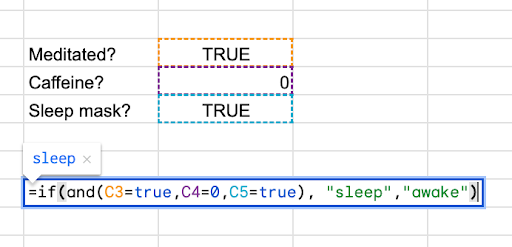
“Microsoft excel” model of insomnia
It is common to come across insomnia stricken people who have this kind of mental model of how sleep works. However, this model of sleep appears to be extremely far from the reality in that one may do all of the “right things”, but still fail to sleep well. As one unsuccessfully takes more steps to “solve” sleep, a sense of sleep anxiety often sets in. Just like anxiety about outside concerns, anxiety about sleep itself makes sleep worse. This is one possible positive feedback loop that can result in clinical insomnia.
I have a revision to this kind of approach. My thought is to bring ourselves one level of abstraction higher and ask “what kind of logic is this?” If one can identify that it’s Microsoft excel logic, then one can know that it will not help insomnia. In other words, instead of asking the specific set of conditions that must be met to result in sleep, instead ask what is the form of your understanding of sleep. If you can identify yourself as being in the if-then logical mindset, your model will at least properly understand that this will not reliably result in sleep.
Now that we have a better model for what will not result in sleep, what do we do to actually get to sleep? There is no single answer, but I would point you to the process of experiential acceptance from ACT. Acceptance is an exceptionally important life skill when understood properly and practiced skillfully. Acceptance is not a resignation to misery. Acceptance is the acknowledgement of one’s internal experiences without trying to deny, avoid, or alter them. If one feels sad, acceptance means allowing for and acknowledging the sadness. Avoiding it might involve something like intellectualizing, overworking, drinking, or one of many other behaviors as a form of circumventing the sadness. Acceptance in insomnia means acknowledging and not trying to deny, avoid, or alter one’s state of being awake or asleep. It might sound like this: “I’m awake right now. I am allowing for this. I know I cannot control this anyway, so I accept it.” In more new age terms, we might say that one surrenders to the state of being awake.
Gregory Bateson, a pioneer systems thinker, would describe this as having a complementary relationship rather than a competitive relationship to wakefulness/sleep. Specifically, we could describe this as having a submissive/dominant relationship to sleep, in which the person submits to wakefulness/sleep. The contrast, which is a competitive relationship, typically results in a self-escalating feedback loop which can look like this:
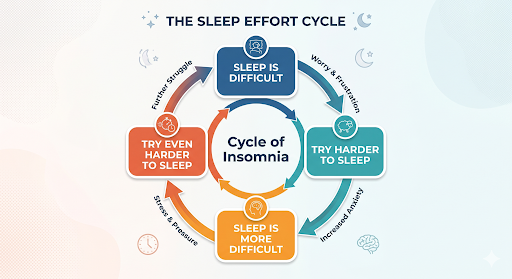
Insomnia positive feedback loop
When one stops trying to solve or defeat insomnia (a competitive relationship), a meaningful amount of energy is reclaimed because it is no longer wasted fighting the insomnia. The reduced sleep struggle itself often leads to clients feeling more energy in their daily lives even if they don’t sleep more hours. In a sense, acceptance of wakefulness/sleep is the human mind submitting to its body. It is the mind trusting that the body already naturally knows what to do, without the intervention of the intellect. When the mind trusts in the natural intelligence of the body, the body tends to respond with sleep.
